"The idea of a vehicle that could lift itself vertically from the ground and hover motionless in the air was probably born at the same time that man first dreamed of flying".
"It would be right to say that the helicopter's role in saving lives represents one of the most glorious pages in the history of human flight."
 Sikorsky Aircraft was founded in 1923 by Igor Sikorsky
as the Sikorsky Aero Engineering Corp, and has been affiliated with United
Technologies Corporation (UTC) since 1929 when it moved to Stratford, Conn., from Long Island.
Sikorsky Aircraft was founded in 1923 by Igor Sikorsky
as the Sikorsky Aero Engineering Corp, and has been affiliated with United
Technologies Corporation (UTC) since 1929 when it moved to Stratford, Conn., from Long Island.
In the 1920s and 1930s Sikorsky produced land-based aircraft, amphibians and flying-boats, including the flying Clippers, which pioneered commercial transoceanic air routes. Since the early 1940s, Sikorsky has concentrated its efforts on helicopters and by 1996, they had produced over 7800 rotary wing aircraft; further 1800 built by foreign licensees .
Today, Sikorsky helicopters occupy a prominent position in the intermediate to heavy range of 11,700 lb (5,300 kg) to 73,500 lb (33,000 kg) gross weight. They are used by all five branches of the United States armed forces, along with military services and commercial operators in 40 nations.
 1909 :
Igor Sikorsky build his first machine in Russia, but this first Sikorsky helicopter
never left the ground, and a second which followed in 1910 fails too, so he stopped
and turn to fixed wing aircraft until 1930.
1909 :
Igor Sikorsky build his first machine in Russia, but this first Sikorsky helicopter
never left the ground, and a second which followed in 1910 fails too, so he stopped
and turn to fixed wing aircraft until 1930.
Sikorsky, who fled from the Bolshevik Revolution in 1917, encouraged the United States Government to agree to a considerable budget of two million dollars for rotary-wing research in 1938. The government ended up choosing a joint Sikorsky-Vought effort to be funded. The resulting machine, the VS-300, was indeed quite different from earlier models.
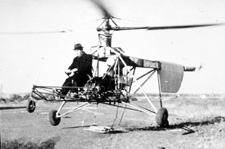
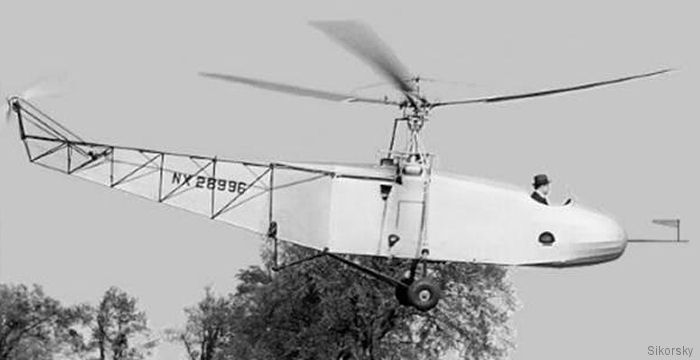
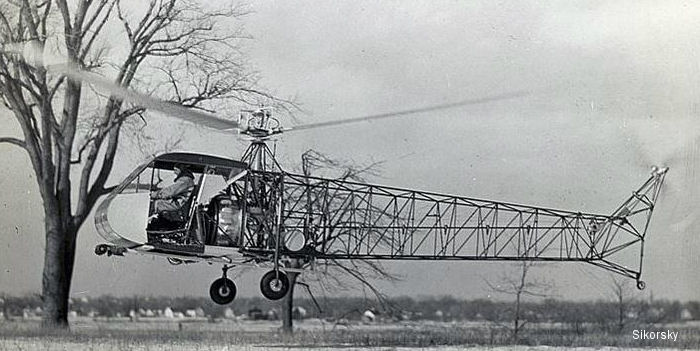
Sept 14, 1939 : VS-300
First flight of an US helicopter. The VS designation was used for several years when the Chance Vought and Sikorsky Divisions of UTC, were combined.
The VS-300 had a four-cylinder, 75 horsepower air-cooled engine, a three-bladed main rotor, 8.53 m in diameter, a welded tubular steel frame; a power transmission consisting of V-belts and bevel gears; a three-wheel landing gear arrangement and a completely open pilot's seat.
July 18, 1940, the VS-300 was able to stay in the air for 15 minutes.
May 6, 1941: with Igor Sikorsky at the controls, established a
world helicopter endurance record of 1 hour, 32 minutes, 26 seconds.
Jan 14, 1942 :
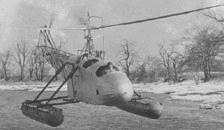
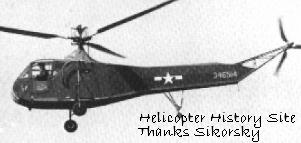
Vought-Sikorsky VS 316 [S-47/S-48/Hoverfly/R-4]
Aug 18, 1943 : Vought-Sikorsky VS 327 ( R-5 / XR-6 )
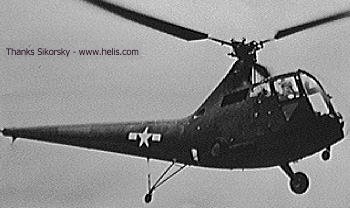
An all metal and bigger than the R-4 was built as XR-5 (prototypes) and YR-5A (pre production) for evaluation by the USAAF.
The Navy designation was HO2S
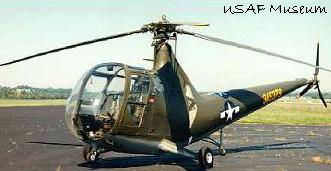
Oct 15, 1943 : Vought-Sikorsky VS 316A Hoverfly II (R-6)
This two-seat helicopter was a refined version of the R-4, more advanced in performance and appearance. The Navy designation was HO5S R-6A :
Rotor diameter: 11.58 m
Length: 11.60 m
Height: 3.4 m
Weight: Max: 1082 kg
Engine: One Franklin O-405-9 of 235 hp.
Speed: 110 km/h Max.154
Range: 565 km
Service Ceiling: 4000 m
June 1945 : USAAF Rescue in the Philippines
Igor Ivanovitch Sikorsky
In the 1920s and 1930s Sikorsky produced land-based aircraft, amphibians and flying-boats, including the flying Clippers, which pioneered commercial transoceanic air routes. Since the early 1940s, Sikorsky has concentrated its efforts on helicopters and by 1996, they had produced over 7800 rotary wing aircraft; further 1800 built by foreign licensees .
Today, Sikorsky helicopters occupy a prominent position in the intermediate to heavy range of 11,700 lb (5,300 kg) to 73,500 lb (33,000 kg) gross weight. They are used by all five branches of the United States armed forces, along with military services and commercial operators in 40 nations.
1909 :
Igor Sikorsky build his first machine in Russia, but this first Sikorsky helicopter
never left the ground, and a second which followed in 1910 fails too, so he stopped
and turn to fixed wing aircraft until 1930.
Sikorsky, who fled from the Bolshevik Revolution in 1917, encouraged the United States Government to agree to a considerable budget of two million dollars for rotary-wing research in 1938. The government ended up choosing a joint Sikorsky-Vought effort to be funded. The resulting machine, the VS-300, was indeed quite different from earlier models.
Sept 14, 1939 : VS-300
First flight of an US helicopter. The VS designation was used for several years when the Chance Vought and Sikorsky Divisions of UTC, were combined.
The VS-300 had a four-cylinder, 75 horsepower air-cooled engine, a three-bladed main rotor, 8.53 m in diameter, a welded tubular steel frame; a power transmission consisting of V-belts and bevel gears; a three-wheel landing gear arrangement and a completely open pilot's seat.
July 18, 1940, the VS-300 was able to stay in the air for 15 minutes.
May 6, 1941: with Igor Sikorsky at the controls, established a
world helicopter endurance record of 1 hour, 32 minutes, 26 seconds.
Jan 14, 1942 :
Vought-Sikorsky VS 316 [S-47/S-48/Hoverfly/R-4]
Developed from the VS-300, was the world's first large-scale mass-produced helicopter.
US and UK armed forces first service helicopter. The Navy designation was HNS
R-4B :
Rotor diameter: 11.58 m
Length: 10.35 m
Height: 3.6 m
Weight: 960 kg
Engine: Warner R-550 of 200 hp.
Speed: Max: 120 Km/h Cruise : 104
Range: 240 km
Service Ceiling: 2430 m
May 6, 1943 :
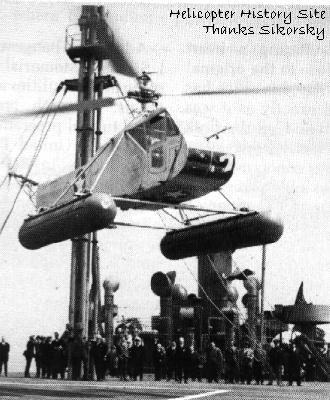
US Navy representatives witnessed landing trials of the XR-4 helicopter
aboard the merchant tanker Bunker Hill in a demonstration sponsored
by the Maritime Commission and conducted in Long Island Sound.
The pilot, Colonel R. F. Gregory, USAAF, made about 15 flights, and in some
of these flights he landed on the water before returning to the
platform on the deck of the ship.
Jul 7, 1943 :
First US Coast Guard Helo Detachment
at Sikorsky Helicopter Airport in Bridgeport, Conn.
US and UK armed forces first service helicopter. The Navy designation was HNS
R-4B :
Rotor diameter: 11.58 m
Length: 10.35 m
Height: 3.6 m
Weight: 960 kg
Engine: Warner R-550 of 200 hp.
Speed: Max: 120 Km/h Cruise : 104
Range: 240 km
Service Ceiling: 2430 m
May 6, 1943 :
US Navy representatives witnessed landing trials of the XR-4 helicopter
aboard the merchant tanker Bunker Hill in a demonstration sponsored
by the Maritime Commission and conducted in Long Island Sound.
The pilot, Colonel R. F. Gregory, USAAF, made about 15 flights, and in some
of these flights he landed on the water before returning to the
platform on the deck of the ship.
Jul 7, 1943 :
First US Coast Guard Helo Detachment
at Sikorsky Helicopter Airport in Bridgeport, Conn.
Aug 18, 1943 : Vought-Sikorsky VS 327 ( R-5 / XR-6 )
An all metal and bigger than the R-4 was built as XR-5 (prototypes) and YR-5A (pre production) for evaluation by the USAAF.
The Navy designation was HO2S
Oct 15, 1943 : Vought-Sikorsky VS 316A Hoverfly II (R-6)
This two-seat helicopter was a refined version of the R-4, more advanced in performance and appearance. The Navy designation was HO5S R-6A :
Rotor diameter: 11.58 m
Length: 11.60 m
Height: 3.4 m
Weight: Max: 1082 kg
Engine: One Franklin O-405-9 of 235 hp.
Speed: 110 km/h Max.154
Range: 565 km
Service Ceiling: 4000 m
June 1945 : USAAF Rescue in the Philippines