| 1945-1950 Highlights |
 US Congress criticized the US Navy for largely ignoring the helicopter's
enormous military potential during a 1943 Senate investigation chaired
by Harry S. Truman
Piasecki PV 3 Dog Ship:
First world's successful tandem-rotor Helicopter (March 7,1945)
See Boeing
Bell 47:
First world's certified civil helicopter NC-1H (March 8, 1946)
See Bell
Mc Donnell Little Henry:
First world's ram-jet helicopter (1947)
See See Mc Donnell Douglas
Sikorsky S-52:
Metal blades rotor (1947)
See Sikorsky
Hiller 360:
First civilian helicopter to cross the United States (1949)
See Hiller
Sikorsky S-51 HO3S-1G
US Coast Guard H035-l completed the longest unescorted helicopter ferry
flight on record. The trip from Elizabeth City, North Carolina, to Port Angeles,
Washington, via San Diego, California, a distance of 3,750 miles, took 10 1/2
days to complete and involved a total flight time of 57.6 hours. (April 6,1949)
US Congress criticized the US Navy for largely ignoring the helicopter's
enormous military potential during a 1943 Senate investigation chaired
by Harry S. Truman
Piasecki PV 3 Dog Ship:
First world's successful tandem-rotor Helicopter (March 7,1945)
See Boeing
Bell 47:
First world's certified civil helicopter NC-1H (March 8, 1946)
See Bell
Mc Donnell Little Henry:
First world's ram-jet helicopter (1947)
See See Mc Donnell Douglas
Sikorsky S-52:
Metal blades rotor (1947)
See Sikorsky
Hiller 360:
First civilian helicopter to cross the United States (1949)
See Hiller
Sikorsky S-51 HO3S-1G
US Coast Guard H035-l completed the longest unescorted helicopter ferry
flight on record. The trip from Elizabeth City, North Carolina, to Port Angeles,
Washington, via San Diego, California, a distance of 3,750 miles, took 10 1/2
days to complete and involved a total flight time of 57.6 hours. (April 6,1949)
|
1942, June 29 :
Following an inspection of Igor I. Sikorsky's VS-300 helicopter on 26 June,
Lieutenant Commander F. A. Erickson, US Coast Guard, recommended that
helicopters be obtained for antisubmarine convoy duty and life-saving.
1942, July 24 :
The US Bureau of Aeronautics issued a Planning Directive calling for procurement of four
Sikorsky helicopters for study and development by Navy and Coast Guard aviation forces.
1943:, US Congress criticized the US Navy for largely ignoring the helicopter's enormous
military potential during a Senate investigation chaired by Harry S. Truman
Frank Piasecki PV 2 :
His first project (not built) , the PV 1, was a NOTAR
class helicopter, but the time 1940 technology wasn't
ready for that advancement yet
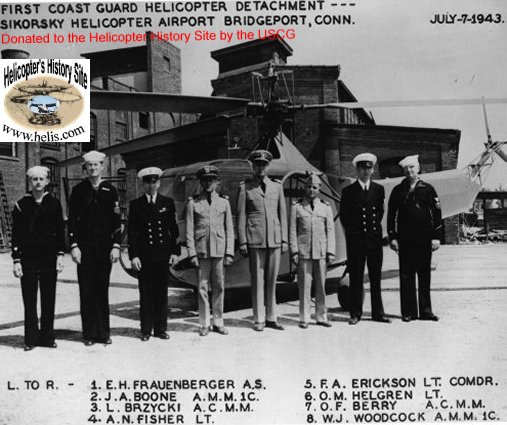 February 15, 1943 :
First USCG helo detachment
The Commander in Chief US Fleet assigned responsibility for sea-going development of
helicopters and their operation in convoys to the Coast Guard and directed that tests be
carried out to determine if helicopters operating from merchant ships would be of value
in combating submarines.
Doblhoff WNF 342 : (Austria)
Built in Germany by Friedrich Von Doblhoff, A. Stepan and Theodor Laufer was the
first to take off and land using slade-tip jets to drive the rotor
May 4 :
To expedite the evaluation of the helicopter in antisubmarine operations, the Commander in
Chief, US Fleet directed that a "joint board" be formed with representatives of the Commander
in Chief, US Fleet; the Bureau of Aeronautics; the Coast Guard; the British Admiralty and the
Royal Air Forces. The resulting Combined Board for the Evaluation of the Ship-Based
Helicopter in Anti-Submarine Warfare was later expanded to include representatives
of the Army Air Forces, the War Shipping Administration and the National Advisory
Committee for Aeronautics.
May 7 :
US Navy representatives witnessed landing trials of the XR-4 helicopter
aboard the merchant tanker Bunker Hill
in a demonstration sponsored by the Maritime Commission and conducted
in Long Island Sound. The pilot, Colonel R. F. Gregory, AAF, made about 15 flights, and in
some of these flights he landed on the water before returning to the platform on the deck
of the ship.
Arthur Young 's
Bell 30.
invention of the stabilizing bar for the main rotor
June 10 :
Lieutenant Commander F. A. Erickson, US Coast Guard , proposed that helicopters
be developed for antisubmarine warfare,
"not as a killer craft but as the eyes and ears of the convoy escorts."
February 15, 1943 :
First USCG helo detachment
The Commander in Chief US Fleet assigned responsibility for sea-going development of
helicopters and their operation in convoys to the Coast Guard and directed that tests be
carried out to determine if helicopters operating from merchant ships would be of value
in combating submarines.
Doblhoff WNF 342 : (Austria)
Built in Germany by Friedrich Von Doblhoff, A. Stepan and Theodor Laufer was the
first to take off and land using slade-tip jets to drive the rotor
May 4 :
To expedite the evaluation of the helicopter in antisubmarine operations, the Commander in
Chief, US Fleet directed that a "joint board" be formed with representatives of the Commander
in Chief, US Fleet; the Bureau of Aeronautics; the Coast Guard; the British Admiralty and the
Royal Air Forces. The resulting Combined Board for the Evaluation of the Ship-Based
Helicopter in Anti-Submarine Warfare was later expanded to include representatives
of the Army Air Forces, the War Shipping Administration and the National Advisory
Committee for Aeronautics.
May 7 :
US Navy representatives witnessed landing trials of the XR-4 helicopter
aboard the merchant tanker Bunker Hill
in a demonstration sponsored by the Maritime Commission and conducted
in Long Island Sound. The pilot, Colonel R. F. Gregory, AAF, made about 15 flights, and in
some of these flights he landed on the water before returning to the platform on the deck
of the ship.
Arthur Young 's
Bell 30.
invention of the stabilizing bar for the main rotor
June 10 :
Lieutenant Commander F. A. Erickson, US Coast Guard , proposed that helicopters
be developed for antisubmarine warfare,
"not as a killer craft but as the eyes and ears of the convoy escorts." To this end he recommended that helicopters be equipped with radar and dunking sonar.
October 16 :
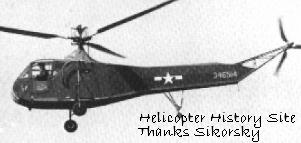
The US Navy accepted its first helicopter, a Sikorsky YR-4B (HNS-1), at Bridgeport, Connecticut, following a 60 minute acceptance test flight by Lieutenant Commander F. A. Erickson, US Coast Guard.
 December 18 :
On the basis of his belief that tests indicated the practicability of ship-based helicopters, the US Chief of Naval Operations separated the pilot training from test and development functions
in the helicopter program. He directed that, effective 1 January 1944, a helicopter pilot training program be conducted by the US Coast Guard at Floyd Bennett Field,
under the direction of the Deputy Chief of Naval Operations (Air).
December 18 :
On the basis of his belief that tests indicated the practicability of ship-based helicopters, the US Chief of Naval Operations separated the pilot training from test and development functions
in the helicopter program. He directed that, effective 1 January 1944, a helicopter pilot training program be conducted by the US Coast Guard at Floyd Bennett Field,
under the direction of the Deputy Chief of Naval Operations (Air).
1944
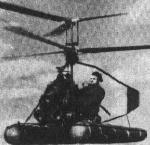
Nikolai Kamov (USSR)
The Ka-8 Vertolet, a single-seat helicopter with a 27 hp M-76 engine, boosted to 45 hp by using alcohol for fuel
 January 3 :
The first US recorded helicopter
lifesaving operation
January 16 :
Lieutenant Graham, US Coast Guard, while en route from New York to Liverpool in the British freighter Daghestan made a 30 minute flight in an R-4B (HNS-1) from the ship's 60 by 80 foot
flight deck.
Weather during the mid-winter crossing of the North Atlantic permitted only two additional
flights and, as a result, the sponsoring Combined Board for Evaluation of the Ship-based
Helicopter in Anti-Submarine Warfare concluded that the helicopter's capability should be
developed in coastal waters until models with improved performance became available.
Cierva-Weir W.9 :
January 3 :
The first US recorded helicopter
lifesaving operation
January 16 :
Lieutenant Graham, US Coast Guard, while en route from New York to Liverpool in the British freighter Daghestan made a 30 minute flight in an R-4B (HNS-1) from the ship's 60 by 80 foot
flight deck.
Weather during the mid-winter crossing of the North Atlantic permitted only two additional
flights and, as a result, the sponsoring Combined Board for Evaluation of the Ship-based
Helicopter in Anti-Submarine Warfare concluded that the helicopter's capability should be
developed in coastal waters until models with improved performance became available.
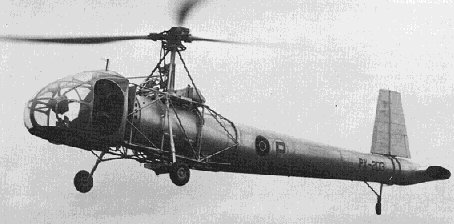
Cierva-Weir W.9 : This helicopter was rather unique in its use of jet thrust to counteract rotor torque reaction and the rotor lacked any collective pitch control, rotor thrust was controlled by changing rotor speed as in the pre-war Weir W-5/6 models. The W-9 crashed during a test flight in 1946.
 July 4 :
Stanley Hiller XH-44
First world's successful all-metal rigid-rotor blades helicopter
Bendix
September :
First helicopter school in the United States is created at
Freeman Field, Seymour
with Sikorsky R-4B helicopters flown direct to the field from the factory.
The school was transferred in December 1944 to Chanute Field, Rantoul, Illinois.
Kellett YO-60 Autogyro could take off without a forward run
July 4 :
Stanley Hiller XH-44
First world's successful all-metal rigid-rotor blades helicopter
Bendix
September :
First helicopter school in the United States is created at
Freeman Field, Seymour
with Sikorsky R-4B helicopters flown direct to the field from the factory.
The school was transferred in December 1944 to Chanute Field, Rantoul, Illinois.
Kellett YO-60 Autogyro could take off without a forward run
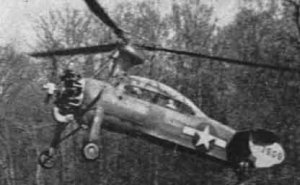
1945
Czech industry is nationalized and all
factories producing aicraft and motor vehicles were formed into a state
consorcium known as
"Ceskoslovenske automobilove a letecke zavody".
The VR-1 is built from salvaged spare parts of German Focke Angelis 223 Drache
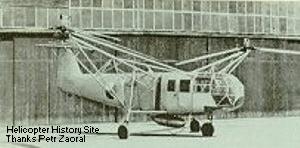 March 7 :
Piasecki PV 3 Dog Ship:
First world's successful tandem-rotor Helicopter
March 7 :
Piasecki PV 3 Dog Ship:
First world's successful tandem-rotor Helicopter
1946
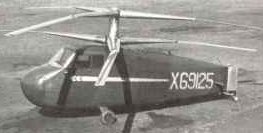
Brantly B-1 : (USA)
N.P.Brantly was one of a number of engineers experimenting with helicopters in the immediate
post-war period. In 1946, he started flight testing his Brantly B-1 helicopter which had been
constructed by his employer, the Pennsylvania Elastic Company. In common with other designers,
he decided on a counter-rotating co-axial twin rotor layout and the B-1 prototype (NX69125)
was powered by a 150hp Franklin engine buried in the tube and fabric fuselage of the craft.
 Aerocentre NC 2001 / 2002 Abeille : (France)
Experimental twin rotor helicopter
Aerocentre NC 2001 / 2002 Abeille : (France)
Experimental twin rotor helicopter
 Firestone Model 45 (R-9 / H-9): (USA)
XR-9B received serial number 46-001
Firestone Model 45 (R-9 / H-9): (USA)
XR-9B received serial number 46-001
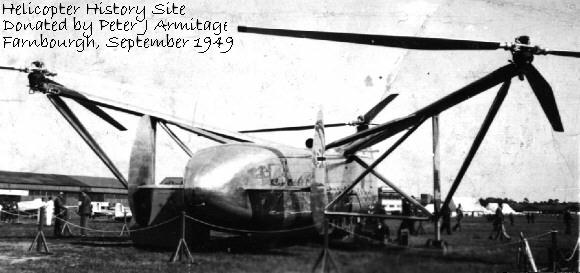
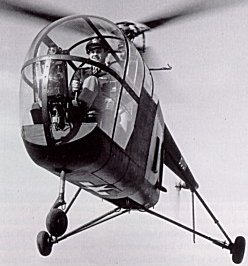 Cierva-Weir W.11 Air Horse (UK)
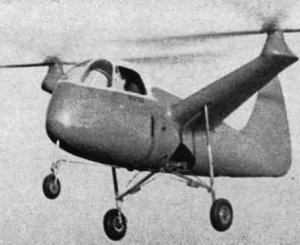
  Landgraf (USA)
Single place twin rotor helicopter with a hinge-less rotor blade for
the US Air Corps
Landgraf (USA)
Single place twin rotor helicopter with a hinge-less rotor blade for
the US Air Corps
 March 8 :
Bell 47: (USA)
First world's certified civil helicopter ( NC-1H )
March 8 :
Bell 47: (USA)
First world's certified civil helicopter ( NC-1H )
1947
January 1st :
Aviation pioneer Martin Jensen establishes the Jensen Helicopter Company on his ranch in
Tonsaket, Washington, USA where he developed the Model 21.
January 10 : UK
Westland signed a licence agreement with United Aircraft Corporation to manufacture the
Sikorsky S-51. This event signalled Westland's move into the helicopter business.
:
Sud-Ouest SO 1100 Ariel (France)|
The first Sud-Ouest (later Aerospatiale ) helicopter, was an all metal, two-seat with Tip jet powered rotors.
July 7 :
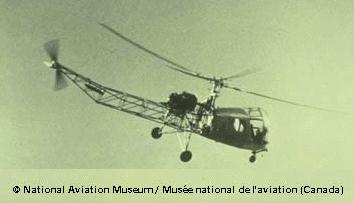
SGVI: First helicopter made in Canada.
 July :
E-1: (Czechoslovakia)
A model of this project worked out at Karlin was shown at Brussels in July 1947. It had two
intermeshing two-bladed rotors, the hubs of which were very close together. Also provided was
a tricycle landing gear with the rear wheels directly below the twin vertical fins.
The project was later canceled.
Mc Donnell Little Henry: (USA)
First world's ram-jet helicopter
Sikorsky S-52: (USA)
First world's helicopter with metal rotor blades.
December 7 :
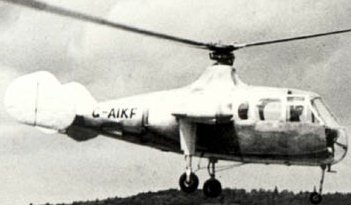
Fairey FB-1 Gyrodyne : (UK)
This compound aircraft used a propeller set on the end of a stub wing to provide both
propulsion and antitorque reaction.
July :
E-1: (Czechoslovakia)
A model of this project worked out at Karlin was shown at Brussels in July 1947. It had two
intermeshing two-bladed rotors, the hubs of which were very close together. Also provided was
a tricycle landing gear with the rear wheels directly below the twin vertical fins.
The project was later canceled.
Mc Donnell Little Henry: (USA)
First world's ram-jet helicopter
Sikorsky S-52: (USA)
First world's helicopter with metal rotor blades.
December 7 :
Fairey FB-1 Gyrodyne : (UK)
This compound aircraft used a propeller set on the end of a stub wing to provide both
propulsion and antitorque reaction.
 Kellett XR-8 / XR-10 ( XH-8 / XH-10 ) (USA)
A twin engined developed for the USAF, held 10 passengers.
Kellett XR-8 / XR-10 ( XH-8 / XH-10 ) (USA)
A twin engined developed for the USAF, held 10 passengers.
1948
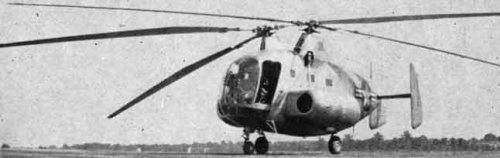
Sud-Est SE 3101 / 3110 (France)
The ancestors of Aerospatiale Alouettes
HERC Jov-3 : (USA)
Designed by Mr. Jovanovich, before he moved to McCulloch
 Robert Stierlin (Switzerland)
Yakovlev Yak-100: (USSR)
August :
Mil Mi-1 Hare
First helicopter to enter series production in the Soviet Union.
October 5 :
Westland WS-51 Dragonfly (UK)
Baumgartl: (Brazil)
After WWII, the austrian engineer Paul Baumgartl moves to Brazil where
he designed and built the PB-60 (1948), PB-63 (1953) and PB-64 helicopters.
Robert Stierlin (Switzerland)
Yakovlev Yak-100: (USSR)
August :
Mil Mi-1 Hare
First helicopter to enter series production in the Soviet Union.
October 5 :
Westland WS-51 Dragonfly (UK)
Baumgartl: (Brazil)
After WWII, the austrian engineer Paul Baumgartl moves to Brazil where
he designed and built the PB-60 (1948), PB-63 (1953) and PB-64 helicopters.
1949
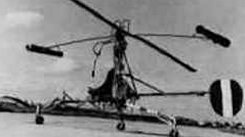
Hiller 360:
First civilian helicopter to cross the United States
Breguet G.11E: (France)
April 6 :
Sikorsky S-51 HO3S-1G:
US Coast Guard H035-l completed the longest unescorted helicopter ferry flight on
record. The trip from Elizabeth City, North Carolina, to Port Angeles, Washington, via
San Diego, California, a distance of 3,750 miles, took 10 1/2 days to complete and involved
a total flight time of 57.6 hours.